Systemic practice
System thinking as the ideal use case for GraphRAG
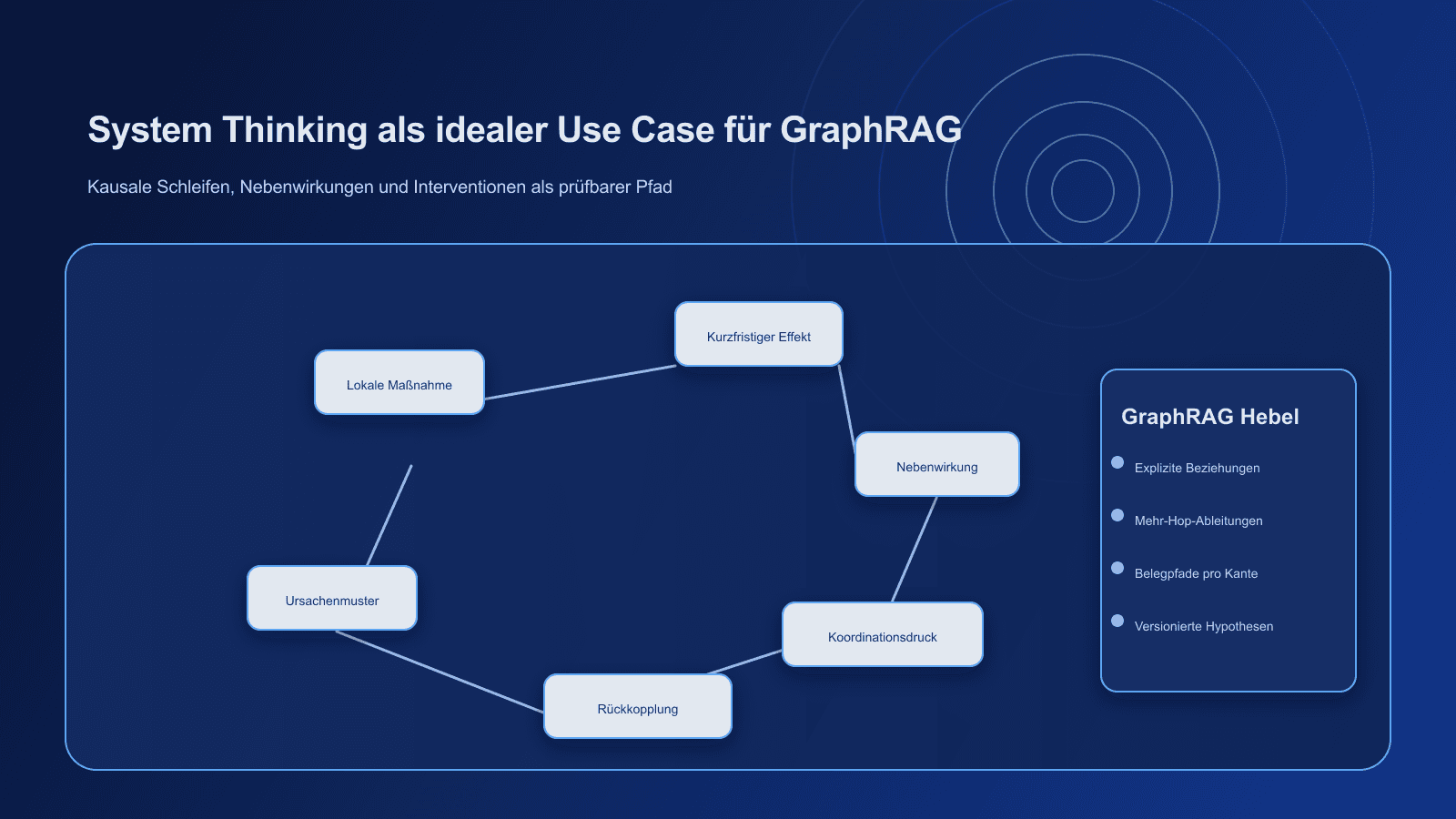
System thinking needs explicit relations, feedback loops, and evidence paths. That is exactly where GraphRAG plays out its structural strength.
Executive Summary
Systemic questions are built on interactions, feedback loops, and trade-offs. GraphRAG makes that structure explicit and therefore reviewable.
Core statement
System thinking is not a text problem, but a structure problem. That is why GraphRAG is not just a good fit, but a logical fit for this mode of thinking.
Core thesis
System thinking is not a thematic niche, but a way of reasoning about complex relationships. This way of thinking works with relations, not with isolated statements.
That is exactly why GraphRAG is structurally better aligned with system thinking than text-centered approaches. It connects concepts, relations, evidence, and reasoning paths into a reviewable model.
The decisive gain is not only better description, but reproducible reasoning across multiple iterations.
System thinking and GraphRAG
Problem context
Typical systemic questions inside organizations are rarely linear:
- Why do coordination costs escalate despite new tools?
- Why do priorities keep shifting permanently?
- Why do problems return even after retrospectives?
- Where do side effects emerge from local optimization?
Such questions usually do not have a single isolated cause. They arise from interactions between teams, processes, goals, and incentive systems.
In text-centered processes, the same pattern often appears:
- individual factors are discussed in isolation,
- feedback loops remain implicit,
- side effects are noticed late,
- follow-up questions restart conceptually from zero.
The result is high discussion intensity with low structural stability. People talk a lot about symptoms, but the underlying system logic is not modeled explicitly.
Structural analysis
1. System thinking is relational thinking
System thinking does not primarily examine things, but the relations between things. An element only becomes understandable through the network of effects around it.
Example:
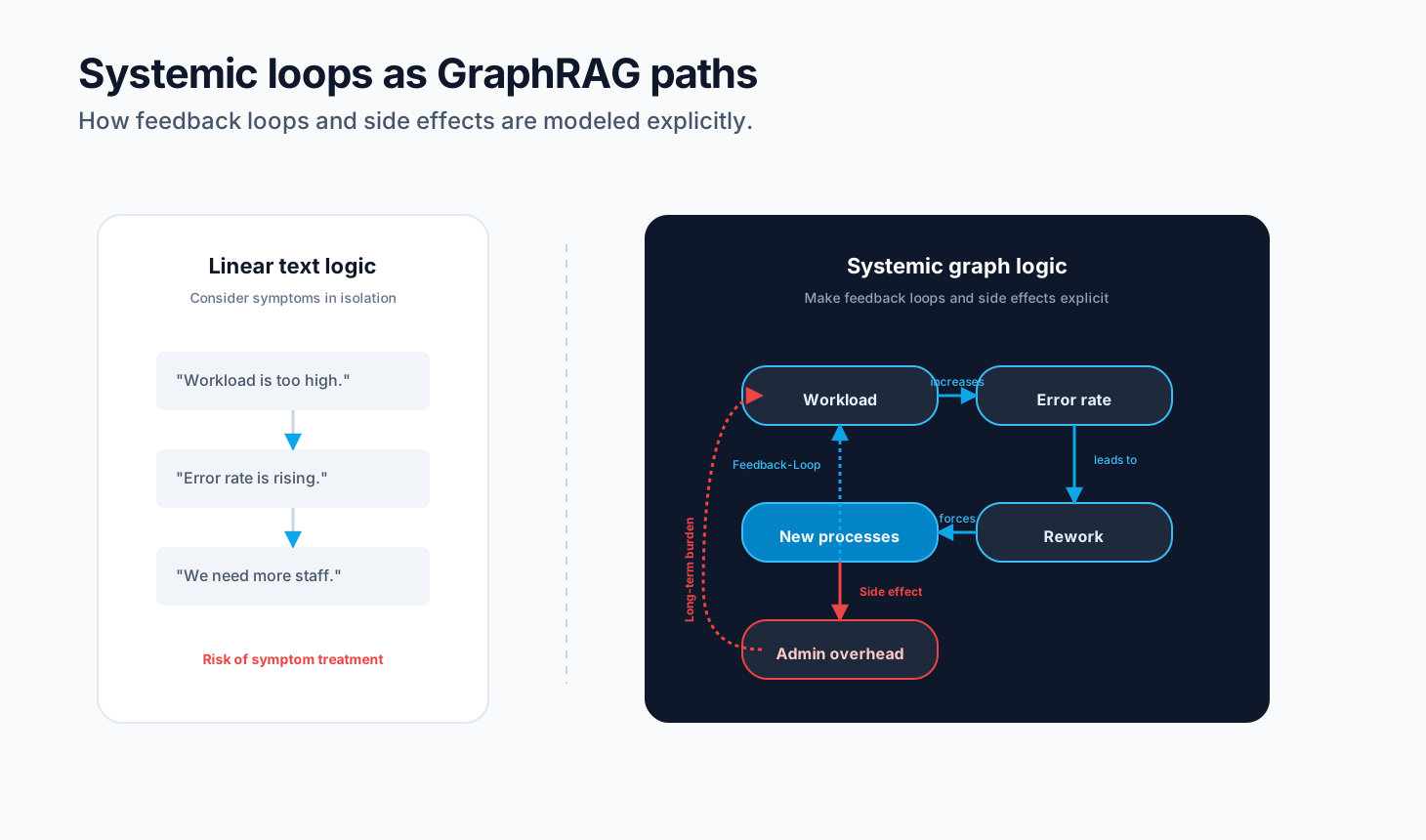
Workload -> error rate -> rework -> additional workload
That is not a linear one-way chain, but a loop. Exactly these loops are hard to represent stably in running prose because they have to be reconstructed implicitly across multiple sentences.
GraphRAG can model this structure explicitly:
- nodes: workload, error rate, rework,
- relation types: increases, causes, reinforces,
- evidence: measurements, observations, documents,
- paths: a traceable derivation from symptom to structure.
That turns discussion into a reproducible model.
2. Multi-hop logic as the core of system thinking
Systemic problems require multi-hop reasoning:
Symptom -> structural cause -> incentive system -> organizational design
Classical RAG often delivers relevant text passages. That is valuable, but often not enough when several levels of effect must be considered at the same time.
GraphRAG navigates explicitly across multiple hops. That keeps indirect effects and cross-dependencies visible instead of letting them disappear inside text.
This is particularly relevant when:
- indirect effects dominate,
- several domains are involved,
- trade-offs operate on different levels.
3. Modeling feedback loops and delays
A central principle in system thinking is that effects often appear with delay and feed back into their own causes.
GraphRAG can represent this logic structurally:
- feedback edges between cause and effect,
- delay marked as a relation property,
- separation of short-term and long-term effects,
- opposing paths for trade-offs.
That makes visible why apparently good measures can produce negative side effects over time.
4. Making side effects explicit
Systemic interventions almost always create side effects. In linear discussions, they are often treated as a side note.
A graph model can represent side effects as separate paths:
- intervention node,
- intended effect path,
- side-effect path,
- evidence per path segment.
This produces a more realistic decision basis: not simply "does it work," but "how does it work in the overall system?"
5. Stability under follow-up questions
Systemic work is iterative. New perspectives change assessment and prioritization.
A graph-based model provides continuity here:
- new nodes can be added,
- existing relations remain traceable and versioned,
- hypotheses can be marked,
- follow-up questions reference the same structural core.
This prevents every subsequent discussion from having to reinvent the underlying logic.
 Systemic loops as GraphRAG paths
Practical perspective
Assume a company asks:
"Why do we lose time in handovers between teams?"
A text-centered approach often delivers isolated explanations:
- communication problems,
- missing documentation,
- unclear responsibilities.
A systemic GraphRAG approach can instead make a structure visible:
- local optimization goals -> fragmented accountability,
- fragmented accountability -> follow-up questions,
- follow-up questions -> loss of time,
- loss of time -> additional coordination pressure,
- coordination pressure -> even more coordination.
That shifts the discussion from symptom description to pattern diagnosis. Interventions become more targeted because they act at the structural level.
Organizational impact
When system thinking is modeled structurally, collaboration changes noticeably:
- discussions become more precise because concepts and relations are explicit,
- trade-offs become visible instead of disappearing into compromise language,
- assumptions become reviewable instead of remaining person-bound,
- measures are documented as paths and can be evaluated later.
At the same time, GraphRAG acts as:
- a thinking tool,
- a discussion surface,
- a documentation structure,
- a decision archive.
That strengthens collective learning and reduces dependence on individual "systems thinkers".
Limits and trade-offs
System thinking remains demanding. GraphRAG does not automatically solve:
- missing domain clarity,
- political conflict,
- unclear accountability,
- weak decision discipline.
It makes these issues more visible, but not automatically easier.
It also creates practical costs:
- modeling effort,
- concept alignment across teams,
- maintenance and versioning,
- risk of over-structuring.
Without clear quality rules, the result can become a complex graph with little explanatory power.
Typical anti-patterns in systemic GraphRAG setups
Especially in early rollouts, recurring patterns appear that reduce the benefit sharply:
- Graph without semantic discipline
Nodes are added quickly, but concepts are not delimited carefully. That creates density instead of clarity. - Feedback without evidence
Loops are modeled, but not backed by evidence. The paths then look convincing while remaining fragile in domain terms. - Intervention without trade-off visibility
Intervention paths show only intended effects. Side effects stay invisible and later lead to misalignment. - Discussion without version logic
Relations change without traceable documentation of the change. Teams lose their shared context.
A productive setup therefore needs not only a good diagram, but clear rules for concepts, evidence, and change control.
Maturity check for systemic use
A team can assess its maturity quickly. If two or more questions are answered with "no", structural stability is usually missing:
- Can we name at least one complete feedback path for a central question?
- Are side effects modeled as their own paths with supporting evidence?
- Do core claims stay consistent under follow-up questions?
- Can new team members understand the decision path without oral explanation?
- Are hypotheses, facts, and assumptions clearly distinguished?
This check does not replace deep evaluation, but it reveals early whether systemic discussion has already become systemic decision capability.
Rollout plan in three iterations
A pragmatic start usually succeeds in three iterations:
- Diagnosis iteration
Select one recurring symptom field and model the first causal path with evidence. - Stabilization iteration
Consolidate relation types, add side-effect paths, and establish review rituals. - Scaling iteration
Connect the model to real decision cycles, measure answer stability, and formalize governance rules.
That way, the system thinking model grows in a controlled way from an analysis aid into robust decision infrastructure.
Conclusion
System thinking is a relational model of reasoning. GraphRAG is a relational model of context.
This structural fit is what makes system thinking the ideal use case. Where causal chains, feedback loops, and side effects dominate, linear text logic is no longer enough.
In those situations, explicit concepts, relations, and evidence paths are required. GraphRAG turns systemic argumentation into something that is not only describable, but modelable and reviewable.
Systemic quality does not emerge from more text, but from explicit structure.
How this structural gain can be turned into a robust organizational framework for positioning and governance is the subject of the next essay.
Next steps
- Choose one recurring systemic question in your organization.
- Model at least three cause-and-effect relations explicitly.
- Add at least one side-effect path with supporting evidence.
- Use the model as the discussion surface in a real review.
- Check whether follow-up questions are answered more stably than in text-centered discussions.