Systemic practice
GraphRAG as a decision interface for organizations
GraphRAG becomes strategically relevant when it connects domain context, evidence, and reasoning inside a workable decision surface.
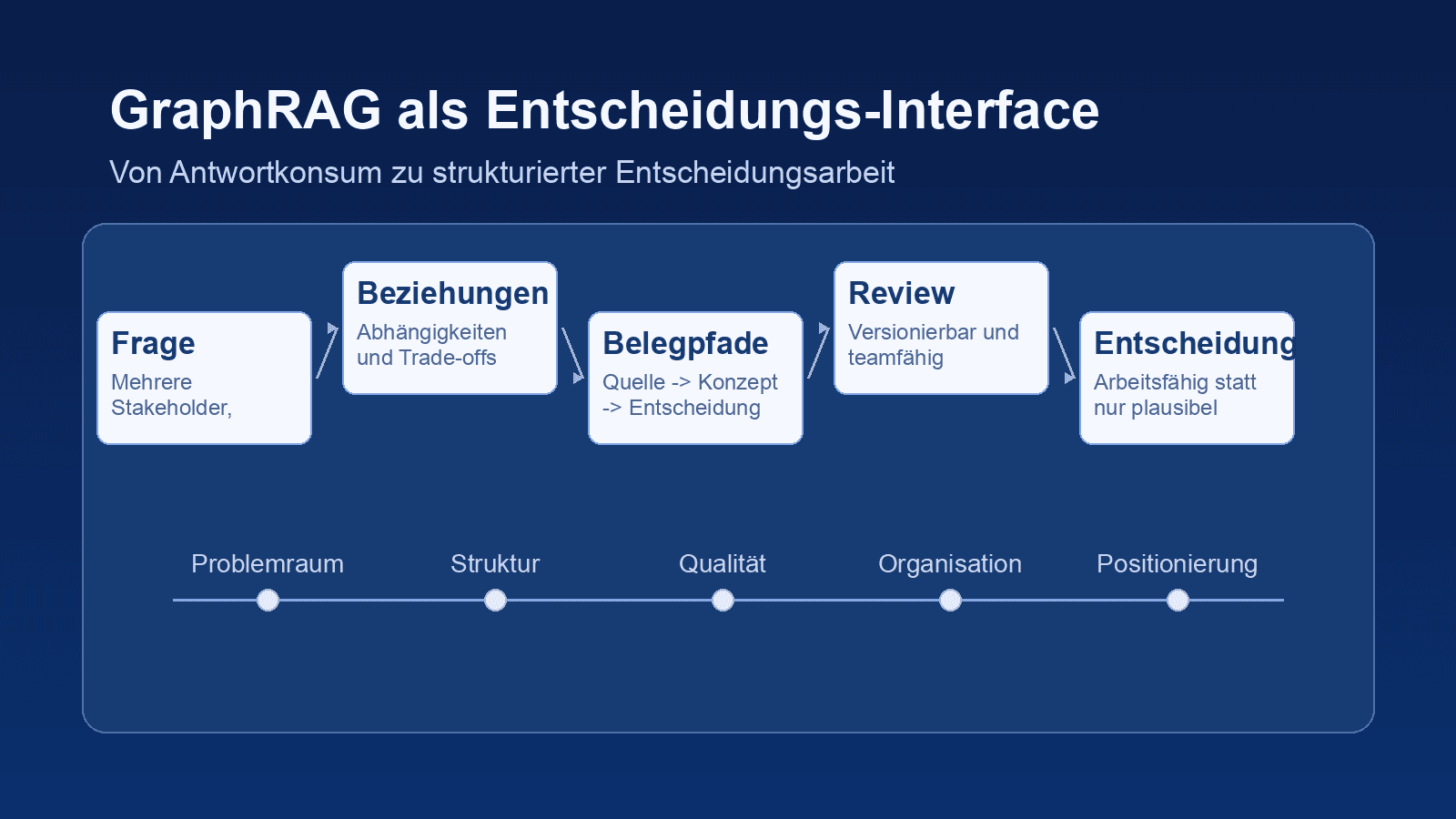
Executive Summary
The real leverage is not more answers, but a reviewable decision surface built from concepts, relations, evidence, and paths.
Core statement
GraphRAG is not a better search box. It is a decision interface that puts discussion, review, and governance onto the same structure.
Core thesis
Organizations do not make decisions on the basis of isolated texts. They make decisions on the basis of concepts, dependencies, trade-offs, evidence, and follow-up questions.
GraphRAG makes these elements explicit and connects them in a workable structure. That is exactly how an answer system becomes a decision interface.
The value does not primarily lie in better phrasing, but in structured collaboration between domain work, architecture, and governance.
GraphRAG as a decision interface
Problem context
Typical decision processes in organizations are text-centered:
- A question appears.
- Stakeholders research and ask LLMs.
- Results are discussed in meetings.
- Arguments are merged manually.
- Decisions are documented, often in shortened or implicit form.
This creates recurring problems:
- reasoning paths are not documented in a stable way,
- terms are interpreted differently across teams,
- evidence is linked only loosely to statements,
- follow-up questions effectively restart from zero.
The result is a process with high communication overhead and low structural continuity. Decisions seem plausible in the moment, but they are hard to reproduce across iterations.
Structural analysis
1. From answer system to structural model
Classical LLM usage produces answers. A decision interface produces structure.
GraphRAG models:
- concepts as nodes,
- relations as edges,
- evidence as referenceable sources,
- reasoning paths as navigable chains of argument.
Together, these four elements form a reviewable decision logic. The team sees not only the result, but the path that led there.
2. Three layers of a decision interface
A productive GraphRAG interface covers at least three layers.
a) Context layer
Which concepts are in scope? Which relations are relevant? Which evidence supports the argument?
b) Derivation layer
How does the path lead from the question to the conclusion? Which assumptions are modeled explicitly?
c) Discussion layer
Where do alternative relations exist? Which pieces of evidence are disputed? Which terms need sharper definition?
These layers allow teams not only to consume answers, but to actively work on decision models.
3. Stability across iterations
In organizations, decisions rarely emerge in a single step. They develop across multiple reviews.
A decision interface creates structural advantages here:
- core concepts remain persistent,
- relations can be versioned,
- follow-up questions build on the same structure,
- reviews reference nodes and edges rather than loose text passages.
That reduces friction and increases consistency across teams and points in time.
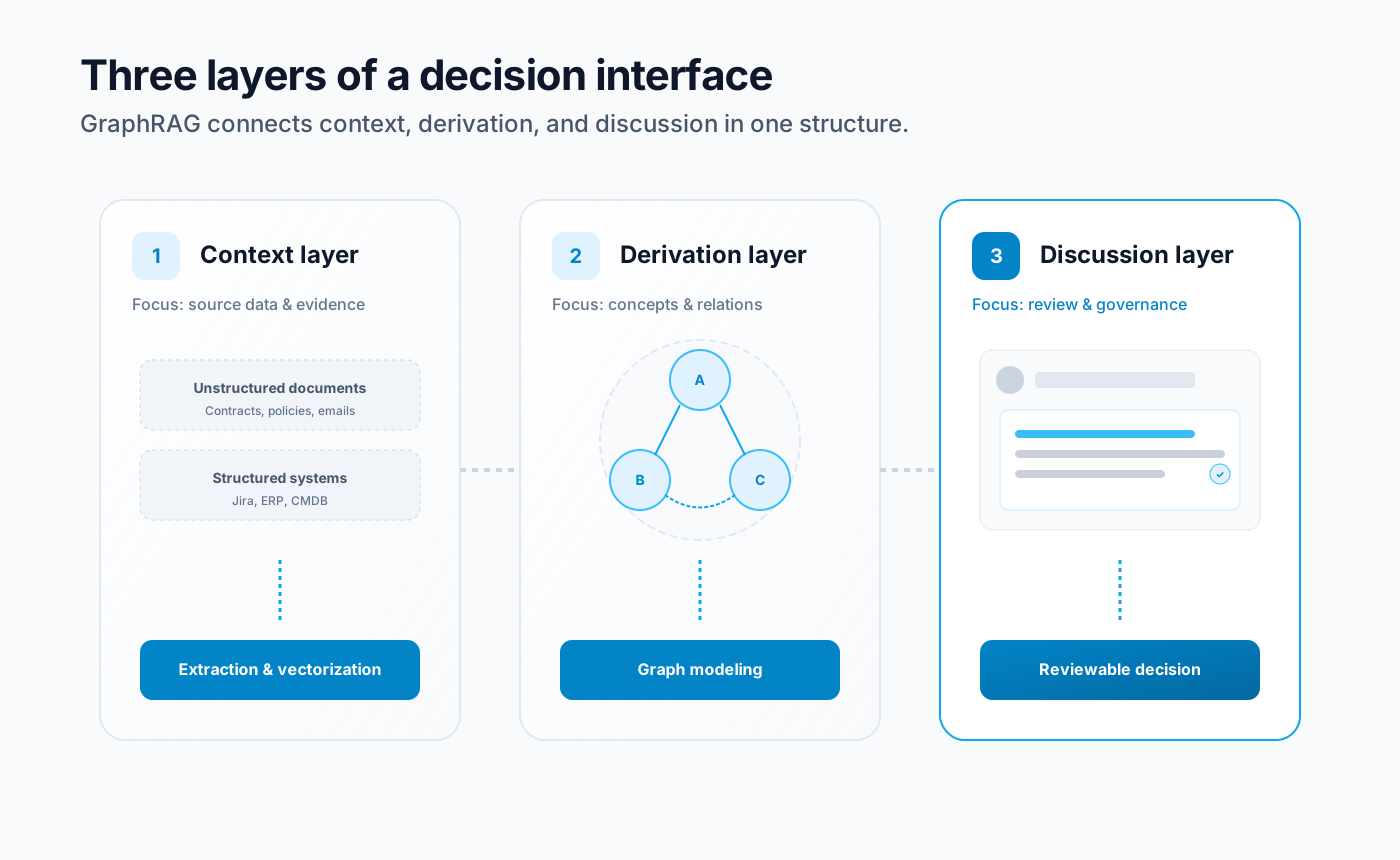 Layers of the decision interface
Practical perspective
Assume a company is evaluating:
"Should a platform component be outsourced or operated internally?"
A text-centered process usually produces:
- lists of pros and cons,
- general references,
- individual opinions from different roles.
A decision interface adds:
- explicit dependencies such as
compliance -> data sovereignty -> risk, - modeled trade-offs such as cost vs. scalability vs. complexity,
- referenced evidence paths,
- stable concept systems for follow-up questions.
This shifts the discussion from "What does which document say?" to "Which relation is modeled correctly in domain terms?" That shift is what increases the team's ability to work.
Organizational impact
A structured decision interface changes multiple dimensions at once.
1. Accountability
Assumptions are modeled explicitly. Responsibilities become clearer because changes to relations and evidence remain traceable.
2. Reviewability
Approvals refer to concrete structural decisions, not just to narrative text. That makes reviews faster and more robust.
3. Documentation quality
Decisions remain reusable over time. Later teams can understand why a specific path was chosen.
4. Knowledge persistence
Insights land in the graph model instead of isolated meeting notes. Knowledge therefore becomes team-capable rather than person-bound.
That is how decision infrastructure emerges instead of mere answer automation.
Operating model for organizations
For GraphRAG to work as an interface, it needs a simple but clear operating model.
-
Model gate
New node and relation types are reviewed from a domain perspective before they are used productively. -
Evidence gate
Critical claims must be bound to concrete sources, including version and validity period. -
Prompt gate
Role instructions and answer constraints are documented, versioned, and kept reviewable. -
Review gate
Decision-relevant runs receive explicit sign-off with a reference to the reasoning path that was actually used.
This operating model prevents semantic drift as the system grows in usage.
Limits and trade-offs
GraphRAG as a decision interface requires:
- disciplined concept work,
- disciplined relation types,
- curated evidence,
- UX transparency,
- governance rules.
Costs appear in:
- initial modeling,
- continuous maintenance,
- cross-functional alignment.
Not every decision needs this level of structure. For simple information lookups, classical RAG is often more efficient.
GraphRAG is most valuable when:
- multiple stakeholders are involved,
- trade-offs exist,
- auditability matters,
- decisions have long-term consequences.
Maturity of a decision interface
A GraphRAG system only becomes a real decision interface when:
- concepts are defined in a stable way,
- relation types are controlled,
- evidence paths remain traceable,
- prompt logic is transparent,
- answers stay consistent across iterations.
Without these criteria, it remains a visualization tool. With them, it becomes a robust working surface for complex decision processes.
Quick assessment for leadership teams
A short self-check helps assess the current maturity level realistically. If two or more questions are answered with "no", a central interface gate is usually missing:
- Can we trace the full evidence path for a key decision in under one minute?
- Do reviews reference concrete nodes and relations instead of loose text passages?
- Does the core claim stay stable across semantically similar follow-up questions?
- Are changes to prompt logic and relation types versioned and auditable?
- Can new stakeholders understand the current decision state without oral briefing?
This check does not replace deep analysis, but it reveals early whether the system already scales as a team capability or still depends heavily on individuals.
Rollout model in three waves
Organizations do not need to build a full decision interface immediately. A staged rollout reduces risk:
- Start wave
Select one recurring decision question and build a small core model with 5 to 10 concepts. - Stabilization wave
Define relation and evidence rules, establish review rituals, and document context packages per run. - Scaling wave
Connect additional teams, introduce metrics for answer stability, and formalize governance gates.
That creates not only a technically working graph, but an organizationally usable decision instrument.
Measurement points in ongoing operations
To keep the interface effective over time, a few clear measurement points should be tracked continuously:
- review duration per decision path: does coordination effort fall over iterations?
- path completeness: how many core claims are backed by explicit evidence?
- answer consistency: does the conclusion remain stable under slightly varied questions?
- concept drift: how often do node definitions need later correction?
These metrics reveal whether the interface merely looks good or truly improves decision work. They also create a shared language across domain teams, architecture, product, and governance about actual decision quality.
Conclusion
GraphRAG becomes strategically relevant when it is understood as an interface, not as a pure optimization of context selection.
It connects context, structure, evidence, derivation, and discussion in a reviewable surface. In that way, AI shifts from "answer generator" to "decision infrastructure".
In organizations that make complex and interconnected decisions, exactly this gain in structure becomes the real competitive advantage.
In organizations, decision capability is not a text problem, but an interface problem.
How system thinking makes this interface approach visible in especially complex problem spaces is the subject of the next essay.
Next steps
- Identify one recurring decision question with multiple dependencies.
- Model 5 to 10 core concepts and their central relations explicitly.
- Attach at least one robust piece of evidence to each critical node.
- Use the model as the discussion surface in a real review.
- Evaluate whether the structure answers follow-up questions more stably than text-centered approaches.
Continue in the argument flow
Step 05: Positioning
Drill-down in this thread
System Thinking Use Case