Systemic practice
From plausible answers to reviewable decisions
How plausible-sounding answers become reviewable foundations for decision-making.
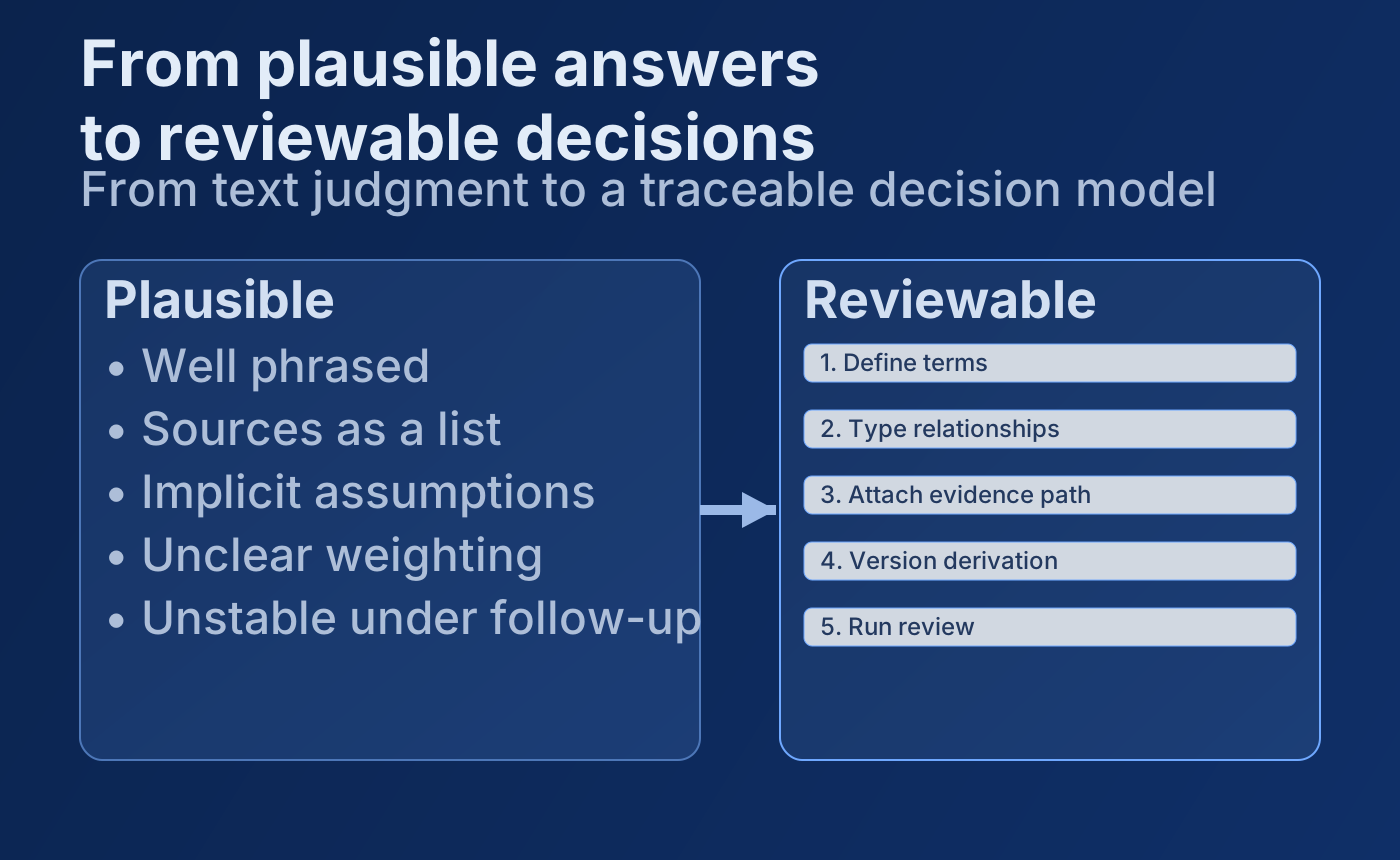
Executive Summary
Plausible answers are useful for orientation. Reviewable decisions only emerge when concepts, relations, evidence, and paths are modeled and versioned explicitly.
Core statement
Decision capability does not emerge from better wording, but from visible reasoning.
Core thesis
Organizations do not make decisions on the basis of text alone, but on the basis of structure. They need explicit concepts, clearly defined relations, robust evidence, and traceable reasoning paths.
LLM-only often produces plausible text. Graph-based, structured approaches enable reviewable reasoning. The transition from plausible to reviewable is therefore not a prompt trick, but an architectural decision.
From plausible to reviewable
Problem context
Modern language models quickly provide:
- well-formulated answers,
- structured pro-and-con lists,
- summarized sources,
- apparently consistent arguments.
That is often enough for exploration. But as soon as architecture, product, or organizational decisions are affected, the bar rises:
- decisions must be defensible to third parties,
- assumptions must be explicit,
- trade-offs must become visible,
- follow-up questions must not destabilize the logic.
A typical misconception is: if the answer sounds plausible, it is ready for decision use. In practice, however, one thing appears again and again: plausibility is not the same as robustness.
Structural analysis
1. Plausibility is probabilistic
LLM answers emerge from compressed probability. The text appears coherent, but:
- assumptions remain implicit,
- weighting remains invisible,
- alternatives are not modeled explicitly,
- reasoning steps are not versioned.
The answer is an outcome, but not an explicit decision process. That is exactly where the break lies between "sounds good" and "is auditable".
2. Decision capability needs four structural building blocks
a) Explicit concepts
Concepts must be defined clearly and separated from each other. Without conceptual precision, pseudo-consistency appears.
b) Transparent relations
Which cause affects which effect? Which intervention amplifies which risk? Which dependency creates which trade-off? Without explicit relation types, argumentation remains implicit.
c) Evidence paths
Not only sources matter, but also this question: which piece of evidence supports which step of the argument? A list of references does not replace a traceable path.
d) Stability across iterations
Decisions emerge iteratively. A robust model stays consistent across semantically similar follow-up questions. If the core claim shifts with slight wording changes, structural stability is missing.
3. The transition from text to model
The shift from plausible answer to reviewable decision happens in three steps:
- Explication
Implicit assumptions and concepts are modeled as nodes. - Relationalization
Relations between concepts are typed and documented. - Evidence binding
Core claims are bound to traceable sources.
Only then does decision readiness emerge.
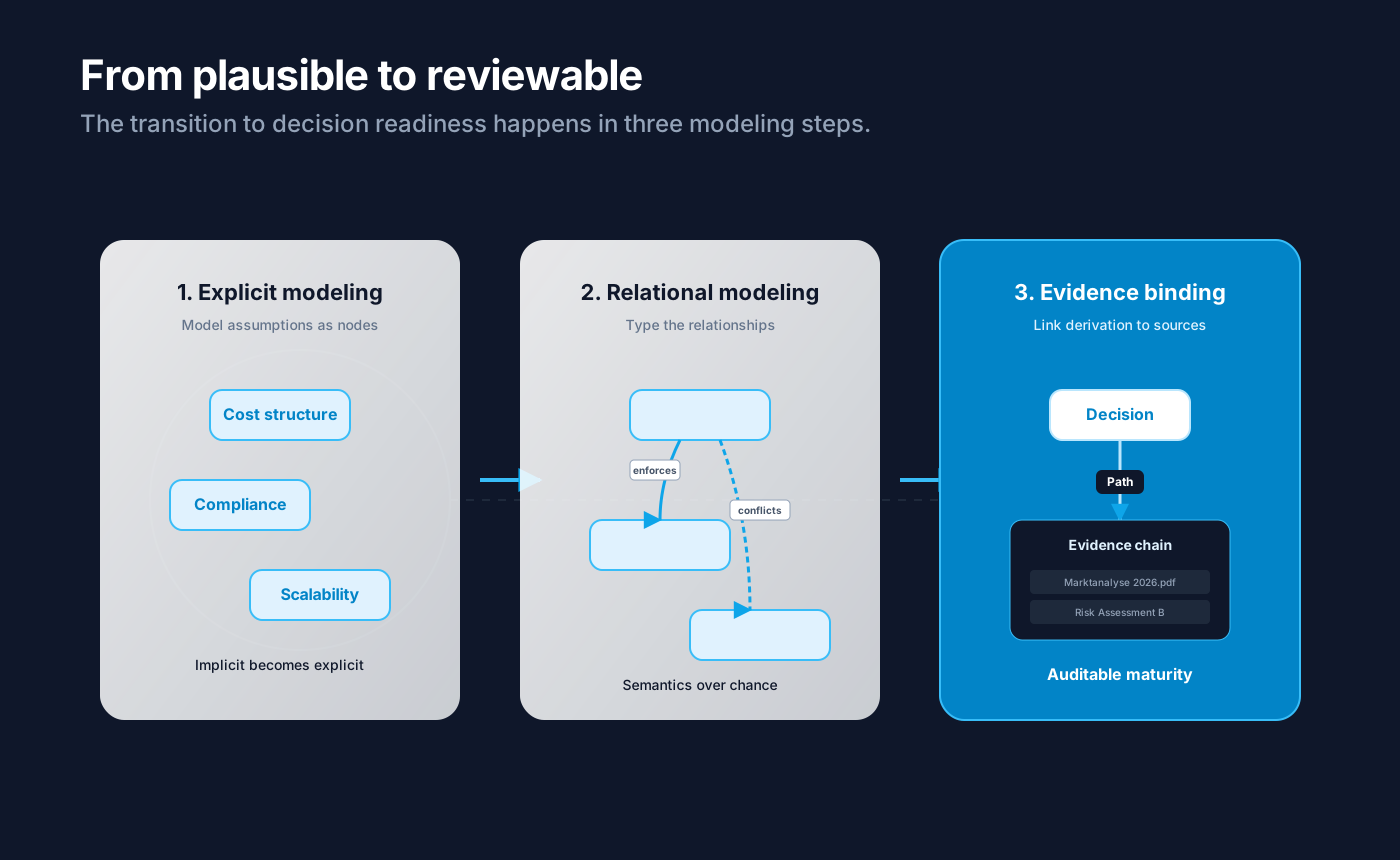 Decision readiness flow
Practical perspective
Example: A company is evaluating the outsourcing of a platform component.
Plausible answer
- lower costs,
- higher scalability,
- greater dependency,
- possible compliance risks.
Reviewable structure
Nodes
- cost structure,
- scalability,
- compliance requirements,
- data sovereignty,
- vendor dependency.
Relations
- outsourcing reduces fixed costs,
- outsourcing increases dependency,
- dependency increases strategic risk,
- compliance limits data transfer.
Evidence paths
- market analysis,
- internal risk assessment,
- regulatory requirements.
Derivation
If compliance is highly critical and data sovereignty remains strategically relevant, the dependency risk outweighs the cost benefit.
The difference does not lie in the amount of text, but in the explicit structure of the argument.
Governance perspective
Reviewable decisions require:
- versioned concept definitions,
- controlled relation types,
- documented context packages,
- visible prompt logic,
- reproducible runs.
Only then can a team:
- conduct reviews efficiently,
- correct assumptions in a targeted way,
- audit decision logic,
- continue iterations consistently.
Without this structure, decision quality remains person-dependent.
Operational model for the transition
To turn plausible answers into a robust decision process, a simple but disciplined operating model is needed.
1. Intake gate
Every question is briefly classified before a run:
- exploratory or decision-relevant,
- low or high context impact,
- low or high governance requirement.
Only decision-relevant runs must necessarily satisfy the full structural path.
2. Structure gate
Before an answer is approved, the following is checked:
- are the key concepts defined unambiguously?
- are relation types consistent?
- are trade-offs marked explicitly?
- is there at least one robust evidence path?
If any of these points is missing, the result remains a draft rather than a decision basis.
3. Review gate
A domain review references not only text, but explicitly:
- affected nodes,
- disputed edges,
- open assumptions,
- missing evidence.
That makes review reproducible and reusable.
4. Version gate
When prompt logic, context selection, or relation types change, a diff is generated. This keeps it visible why a conclusion changed compared with earlier runs.
This four-gate model reduces interpretive chaos and makes decision work team-capable.
Anti-patterns in practice
Certain patterns reliably prevent the transition from plausible to reviewable:
- Sources without path logic
Sources are displayed, but not bound to concrete argument steps. - Concepts without definition
Core concepts shift in meaning across runs. - Prompt without transparency
The answer looks precise, but nobody knows which active rules shaped it. - Iteration without versioning
Relations are adjusted without a traceable history of change.
These anti-patterns are often hard to notice as long as only the final answer is evaluated. They become visible only when structure and run context are documented explicitly.
Limits and trade-offs
The gain in structure has costs:
- modeling effort,
- cross-functional alignment,
- maintenance and versioning,
- the danger of over-modeling.
Not every decision needs this level of structure. A pragmatic rule is: the higher the context complexity and decision impact, the more necessary explicit reasoning becomes.
Maturity check
A decision process is reviewable when:
- key concepts are defined explicitly,
- every core claim has a traceable evidence path,
- follow-up questions do not destabilize the underlying logic,
- new stakeholders can understand the decision path without oral explanation,
- prompt logic and context packages are versioned.
If two or more of these points are missing, the decision remains plausible, but not robust.
Measurable quality indicators
Without metrics, "reviewable" remains a gut feeling. A small KPI set is often enough to make progress visible:
- path completeness
Share of decision-relevant claims backed by explicit evidence paths. - answer stability
Variance of the core claim under semantically similar follow-up questions. - review time to approval
Duration from the first run to domain sign-off. - concept drift per iteration
Number of later corrections to central concept definitions. - context-discipline ratio
Ratio between the context provided and the argument paths actually used.
These metrics should not be interpreted in isolation. High path completeness combined with falling clarity can indicate over-modeling. What matters is the interaction of traceability, consistency, and decision speed.
Typical misreadings in leadership reviews
In management reviews, three recurring misreadings appear:
- "We have sources, so we are reviewable."
Sources alone are not enough if no explicit support path between claim and evidence is documented. - "The result is consistent, so the logic must be sound."
Formulation can be consistent even when assumptions remain invisible. - "More context automatically increases quality."
Without context discipline, complexity usually grows faster than decision readiness.
A structured decision process addresses exactly these misreadings and shifts discussions from language effect to reasoning quality.
Implementation model in three iterations
A practical rollout can proceed in three iterations:
- Pilot iteration
Choose one real decision question and model the first explicit path with evidence. - Stabilization iteration
Sharpen concepts, standardize relation types, and add prompt and context transparency. - Governance iteration
Bring versioning, review gates, and quality metrics into regular operations.
This is how a demo setup becomes a robust decision framework.
Conclusion
Plausible answers are a beginning. Reviewable decisions are a structural product.
The decisive difference lies in:
- explicit concepts,
- typed relations,
- evidence-backed derivation paths,
- iterative stability.
Only when these elements work together does decision capability emerge. It is not better text that determines quality, but visible decision logic.
Decision quality is not a language problem, but a structure problem.
Next steps
- Choose one current decision and make all implicit assumptions explicit.
- Model at least three central relations with clear semantics.
- Add a traceable evidence path for every core thesis.
- Test answer stability with slightly varied phrasing.
- Document prompt logic and the context package for this decision case.