Systemic practice
Prompt Transparency as a Trust Factor
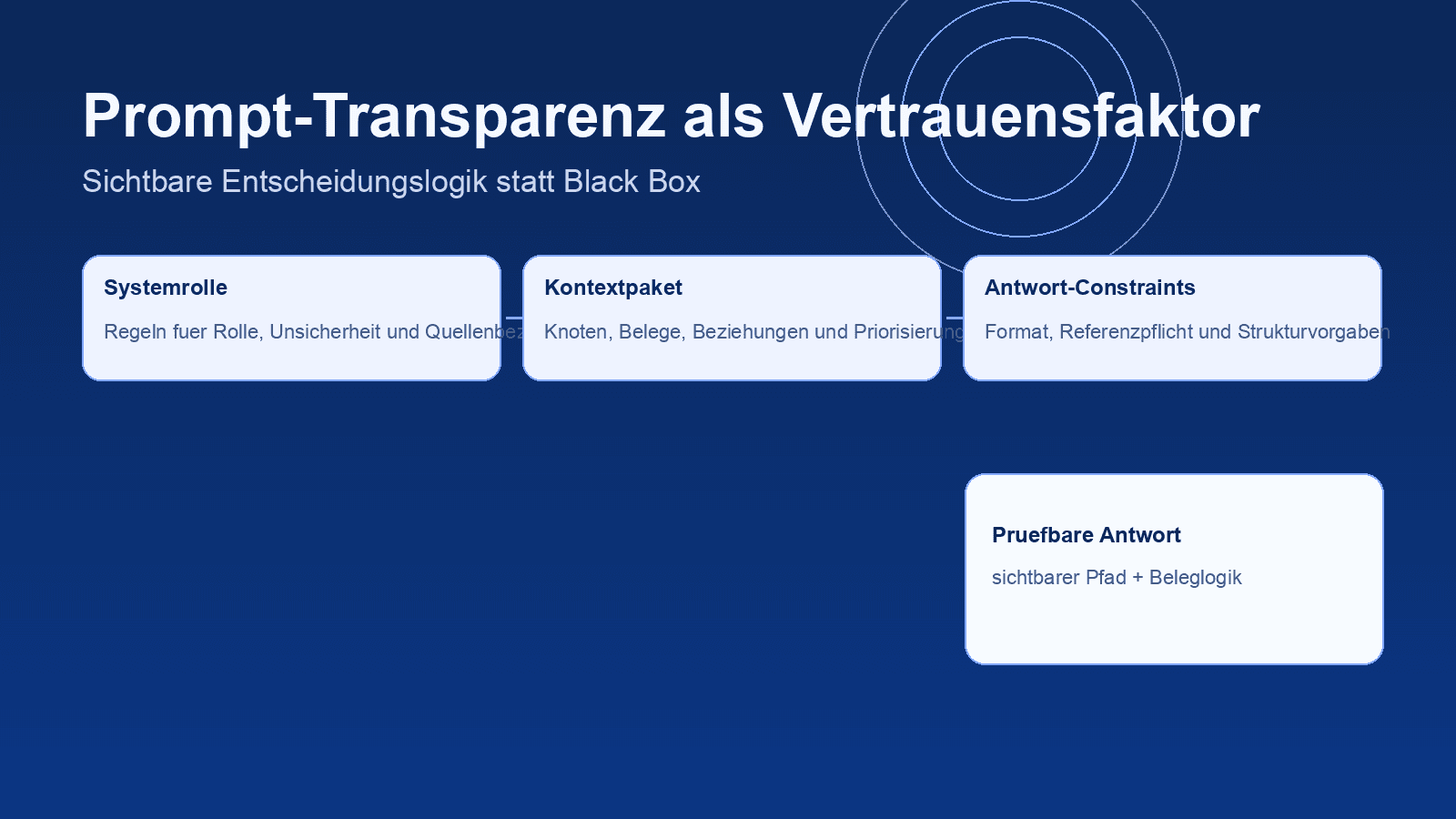
Trust emerges when system role, context package, and answer rules stay visible and reviewable.
Executive Summary
A production-grade GraphRAG system becomes trustworthy when prompt building blocks are made visible in a structured way, versioned, and reviewable.
Core statement
Prompt transparency is not a debug detail. It is the precondition that keeps decisions reviewable and defensible across a team.
Core Thesis
In many AI applications, the prompt remains invisible. Users see only the answer, not the decision mechanism behind it.
For exploratory use, that is often acceptable. For architecture, product, or governance decisions, it is not. In those contexts, teams must be able to understand which rules, context package, and structural constraints shaped the answer.
Prompt transparency makes exactly that mechanism visible. It is therefore not a UX gimmick, but a core building block for resilient decision capability.
Prompt transparency hero
Problem Context
Typical assumptions in AI projects sound like this:
- "The prompt is internal. Users do not need it."
- "Transparency only creates confusion."
- "If the answer sounds plausible, it is fine."
- "Prompting is just an implementation detail."
This viewpoint often works in simple Q&A scenarios. In decision-critical situations, however, it creates structural risks:
- a black-box perception in the business domain
- harder error analysis when answers contradict each other
- discussions about style instead of reasoning
- implicit power shifts toward individual prompt authors
Decision quality then becomes person-dependent instead of system-dependent. That does not scale well in organizations.
Structural Analysis
1. The Prompt Is Part of the Decision Logic
A prompt is not a neutral container. It defines the epistemic frame of the answer:
- which role the model takes
- which sources are treated as valid
- how much uncertainty is tolerated
- which output form counts as "correct"
A short comparison makes the difference obvious:
"Answer freely in everyday language" versus
"Answer only on the basis of the supplied references and mark uncertainties"
Both instructions can produce answers that sound good. But they lead to very different levels of reasoning quality. Without transparency, that difference stays invisible.
2. Three Layers of Prompt Transparency
A production-grade system should make at least three layers visible.
a) Role and system instructions
Which role was set? Which rules apply to tone, structure, source usage, and uncertainty handling?
b) Context package
Which nodes, evidence items, snippets, and summaries actually entered the run? Which parts were deliberately excluded?
c) Answer constraints
Which output form was required? Free text, structured sections, JSON schema, reference fields, maximum length?
These three layers allow structural review instead of pure text evaluation.
3. Transparency Improves Discussion Quality
Without insight into the prompt, teams discuss wording.
With prompt transparency, they discuss system design:
- Is the context too broad or too narrow?
- Is the chosen role appropriate for the question?
- Are the constraints too strict or too loose?
- Are evidence rules or reference obligations missing?
This shifts conversations from opinion to architecture. That is exactly what makes decisions more resilient.
4. Prompt Transparency as a Governance Building Block
In regulated or decision-critical environments, the same question always appears: who defines the decision logic?
If prompt building blocks remain invisible, that logic is barely auditable. If they become visible and versioned, four capabilities emerge:
- traceability
- reproducibility
- reviewability
- change documentation
Prompt transparency is therefore not only a UI concern, but part of governance architecture.
 Layers of prompt transparency
Practical Example
Imagine a team using GraphRAG for architecture decisions.
Variant without prompt transparency
- the answer is shown
- some evidence is visible
- the prompt structure stays hidden
When results feel off, it remains unclear whether:
- the context was selected incorrectly,
- the system role was unsuitable,
- the output constraints were too loose,
- or the model itself reacted unstably.
Variant with a prompt inspector
- role instructions are visible
- the context package is visible per run
- constraints and reference rules are documented
- LLM-only and GraphRAG prompts can be compared
That makes discussion faster, clearer, and more reviewable. Teams no longer correct only outputs, but the underlying decision logic.
Design Principles for Production Prompt Transparency
Prompt transparency must be understandable and operational. Five design principles have proven useful:
-
Semantic structuring instead of a text dump
Prompts should appear in clear blocks: role, context, constraints, synthesis rules. -
Diffs instead of full text for changes
In reviews, what changed matters more than the total current length. -
Context visibility with origin
Every relevant context building block should be traceable back to a node, document, or source. -
Run-specific snapshots
Prompt and context must be versioned per execution so that results remain reproducible. -
Role-specific visibility
Not every user needs full depth. A graduated view prevents overload while preserving auditability.
Limits and Trade-offs
Prompt transparency has costs:
- more UI complexity
- possible overload for less technical users
- additional maintenance effort for versioning
- exposure of internal structural decisions
That is why a graduated model makes sense:
- standard view: focused answer
- expert mode: full prompt and context inspector
The key is not to confuse transparency with raw data overload. Good transparency reduces uncertainty instead of creating new complexity.
Anti-Patterns
-
Transparency only in dev mode
If prompt visibility exists only locally, governance is effectively disabled in production. -
Unstructured prompt output
One long text block without semantic structure makes review harder instead of easier. -
No versioning
Without a traceable prompt history, regressions are hard to analyze. -
Decoupled context display
If the prompt is shown without linked context sources, explainability remains incomplete.
Quick Check for Teams
These four questions provide a fast maturity signal. If two or more are answered with "no," a critical transparency gate is still missing.
- Can we immediately see the active role and constraints for each answer?
- Is the context package documented per run, including origin?
- Are prompt changes versioned and reviewable?
- Can we compare LLM-only and GraphRAG in a structured way when conflicts appear?
The quick check does not replace deep evaluation, but it reveals early whether a system is already decision-capable or still operating in black-box mode.
Implementation Guide in Three Stages
To avoid prompt transparency ending as a one-off UI feature, a clear rollout in three stages helps.
Stage 1: Make visibility possible
At the beginning, a compact inspector with three blocks is enough: active role, context package, and answer constraints. The important point is that this view is run-specific and shows exactly what was actually sent to the model.
Stage 2: Establish reviewability
In the second step, prompt building blocks become versioned, changes become diffable, and everything is tied to a simple approval process. The goal is not bureaucracy, but reproducible quality across model changes, context-selection changes, and team changes.
Stage 3: Connect operational metrics
Only in the third step does transparency become truly steerable: prompt variants are evaluated against answer stability, review effort, and error cases. That creates a control loop of observation, adjustment, and renewed validation.
This staged approach lowers adoption risk. Teams do not need to build the full governance machine immediately, but they get an early and reliable path from "visible" to "controllable."
Conclusion
Trust in AI does not emerge from rhetoric, but from traceable structure.
Prompt transparency:
- makes decision logic visible
- improves discussion quality
- supports governance
- accelerates error analysis
- strengthens trust in the system
In production GraphRAG systems, it is therefore not an optional feature, but part of the quality architecture. A system that reveals its decision logic can be reviewed. A system that hides it remains a black box, even when its answers sound good.
Trust is not a UI effect, but the result of visible structural decisions.
That is exactly why prompt transparency should be treated as a permanent architectural decision, not as temporary debugging help. What is visible, versioned, and reviewable can be improved. What remains invisible escapes systematic quality control.
The next essay examines how GraphRAG as a decision interface makes this transparency useful at team and organizational scale.
Next Steps
- Make the system role and context package visible for each request, at least in expert mode.
- Version prompt building blocks and document changes explicitly.
- Establish a structured comparison between LLM-only and GraphRAG prompts.
- Define a formal review gate for production prompt changes.
- Add operational metrics that make transparency quality measurable.