Systemic practice
Why AI Answers Are Not Enough for Decisions
Plausible AI answers are enough for orientation. For decisions with real consequences, you need visible reasoning, not implicit probability.

Executive Summary
LLM answers provide orientation, but not a resilient basis for decisions. For architecture, product, and organizational decisions, you need explicit concepts, evidence, and derivation paths.
Core statement
Most AI answers sound good. But could you defend an architecture decision with them? As long as the path to the answer stays invisible, it remains a claim.
1. Starting Point
Language models now produce remarkably good answers. They are fast, linguistically clear, and often useful in substance. For exploratory questions, that is a major advantage. Anyone who wants to scan a topic, compare concepts, or form initial hypotheses gets orientation within seconds.
As soon as the topic shifts toward architecture, product decisions, or organizational direction, the requirement changes. In these contexts, it is not enough for an answer to sound plausible. It has to be traceable, reviewable, and defensible to other people. This is exactly where the limits of purely text-based AI answers become visible.
From plausible answer to reviewable reasoning
The central question is therefore not: "Is the answer phrased well?" The decisive question is: "Is the path to the answer visible and robust?"
2. The Structural Problem
2.1 Implicit Reasoning
LLM answers contain an outcome, but the path to that outcome remains implicit. The model compresses probability and context into fluent text. To readers, that text often feels coherent and self-contained, even though the reasoning has not been modeled explicitly.
That leaves several critical anchors missing:
- Which assumptions were made?
- Which concepts were weighted in which way?
- Which alternatives were consciously or unconsciously discarded?
Without this structure, a team can only review the result to a limited degree. The answer is then closer to a suggestion than to a traceable basis for decision-making.
2.2 Source Reference Without Structure
Many systems now add references to answers. That is helpful, but it only solves part of the problem. In many cases, sources remain only loosely connected to the claim.
What remains unclear is:
- which piece of evidence supports which part of the argument,
- whether multiple sources reinforce or contradict each other,
- how a consistent conclusion is derived from the evidence.
The result looks documented, but not truly reasoned. In critical situations, that is not enough.
2.3 Instability Across Follow-Up Questions
Another problem becomes visible in dialogue. When you ask follow-up questions, the justification can shift noticeably. Not necessarily because the model is wrong, but because it recomposes the context probabilistically each time.
That is acceptable for brainstorming. For decisions with real consequences, it is risky. If the same question, phrased slightly differently, leads to a differently justified recommendation, trust in the robustness of the answer declines.
3. What Decisions Actually Need
A resilient decision requires more than linguistic quality. It requires visible structure. Three elements are central here.
3.1 Explicit Concepts
Core concepts need to be named clearly and distinguished from one another. Without conceptual precision, pseudo-certainty and misunderstandings emerge. This is especially critical in cross-functional teams, where different roles interpret the same words differently.
3.2 Transparent Relations
Not only concepts, but also the relations between them need to be visible. Which cause influences which effect? Which dependency amplifies a risk? Which intervention decouples a bottleneck? Only when relations are visible do information fragments become a robust model.
3.3 A Traceable Derivation Path
Finally, it must be clear how the decision was derived from concepts and evidence. That path is what truly matters in reviews, architecture decisions, and governance processes. Without a path, what remains is a claim with good wording.
4. Why This Matters Especially in Organizations
Decisions in organizations are rarely isolated acts. They are prepared, discussed, challenged, documented, and later re-evaluated. That process creates follow-up questions, perspective shifts, and conflicts of goals.
If the reasoning is not visible:
- more follow-up questions are created than necessary,
- interpretations shift between teams,
- trust moves away from the content and onto individual people.
The system then becomes person-dependent instead of structure-dependent. That is exactly what slows down scaling.
A team can work with implicit answers for a while, but over time the coordination burden rises. Every new decision starts from zero again because the argumentative structure cannot be reused in a stable way.
5. Decision Quality Is a System Topic
The quality of decisions depends not only on data or model quality. It depends on whether the reasoning can carry forward into subsequent processes. An answer is high quality when it remains viable in follow-up work.
You can translate that pragmatically into four review questions:
- Are the core concepts explicit and consistent?
- Are the relevant relations visible and plausible?
- Is the evidence chain for the central claim reviewable?
- Does the reasoning remain stable under follow-up questions?
If one of these questions remains open, the decision input is not yet mature.
6. What LLM-Only Still Does Well
It would be wrong to dismiss LLM-only altogether. The approach is strong when the task is orientation, first drafts, or communication relief.
Typical strong use cases:
- quick summaries,
- idea generation and hypothesis building,
- text production and variant comparison,
- FAQ-style questions with clear document grounding.
The problem only starts when that strength is confused with decision robustness.
7. The Shift Toward Reviewable Decisions
The shift from plausible to reviewable is not a matter of a single prompt trick. It is a structural question. Teams need a model in which concepts, evidence, and relations are represented explicitly.
This is exactly where graph-based approaches have clear advantages:
- the concept layer becomes explicit,
- the relation layer becomes visible,
- evidence paths become traceable,
- follow-up questions remain more consistent.
That changes not only answer quality, but also the quality of work inside the team. Discussions become more concrete because disagreements can be tied to visible nodes and edges rather than implicit wording.
8. Practical Framing
Not every decision needs the same degree of structure. For simple, linear questions, a well-referenced text answer may be enough. But as complexity and impact increase, the need for explicit reasoning increases as well.
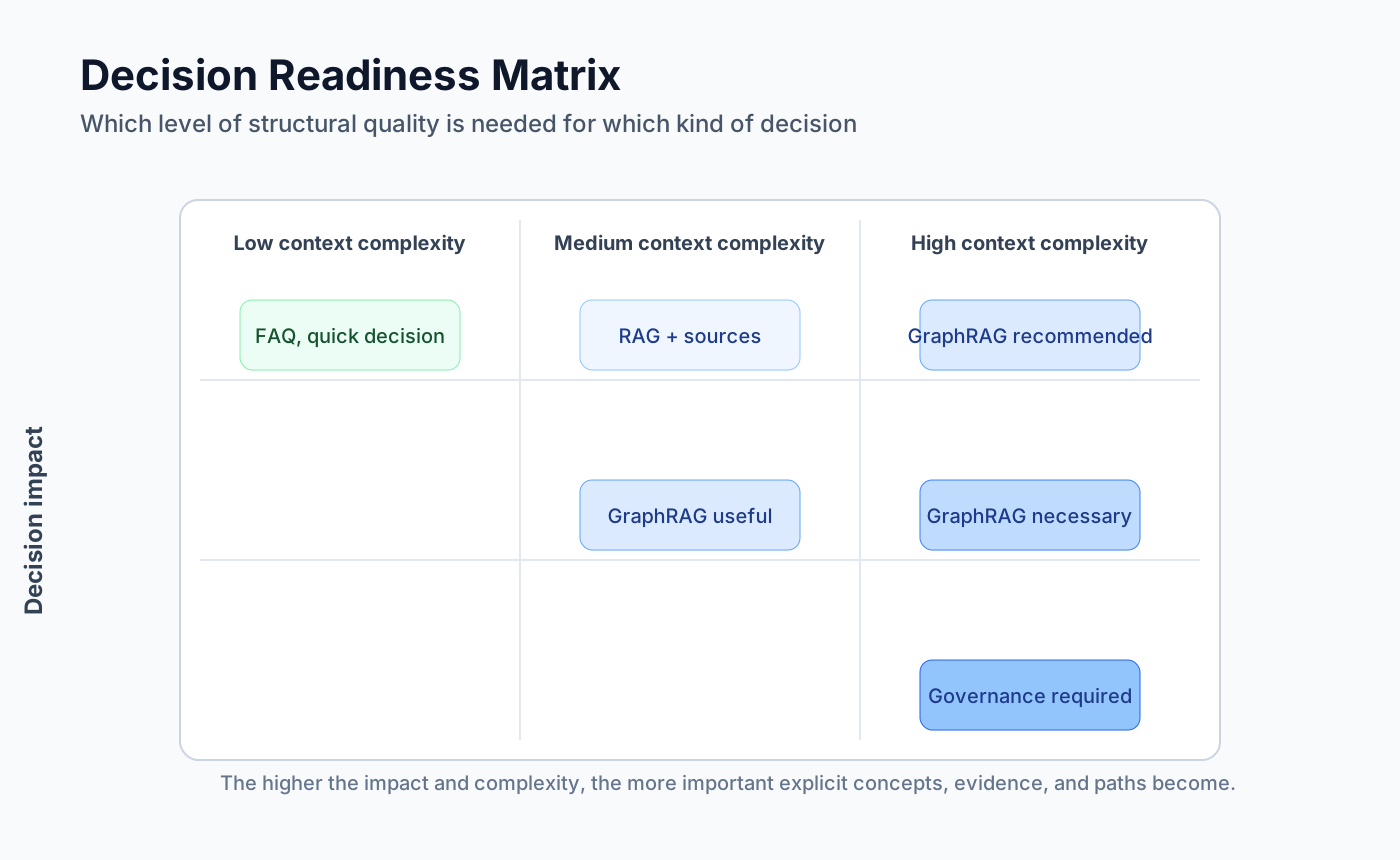 Decision Readiness Matrix
The matrix makes the core point visible: the higher the context complexity and decision impact, the less sufficient LLM-only becomes as a standalone basis. Beyond a certain level, structured derivation is no longer optional, but necessary.
9. Typical Risks if You Do Not Make This Shift
Organizations that stay with implicit answers usually run into recurring patterns:
- Review backlog: decisions are sent back in loops because reasoning gaps remain open.
- Diffused responsibility: it becomes unclear who approved which assumption.
- Knowledge loss: insights stay trapped in isolated answers instead of becoming part of a reusable model.
- Follow-up cost: decisions later have to be corrected at much higher cost.
These costs are rarely visible immediately, but they accumulate significantly over time.
10. Conclusion
LLM answers are powerful and very useful in many situations. They provide orientation, speed, and strong linguistic compression.
For decisions with real consequences, however, they are not enough on their own. What is missing is an explicit structure of concepts, relations, and evidence that makes the path to the conclusion visible.
Only when that structure is modeled does a plausible answer become a reviewable decision. And only then does AI support become a resilient part of professional decision processes.
Decision capability is not a model problem. It is a structure problem.
What such a structure can look like in practice is the subject of the next essay.
Continue in the argument flow
Step 02: Structure