Systemic practice
What I Learned Building a Public System-Thinking GraphRAG Lab
A public MVP with Vercel, Neo4j, and OpenAI is feasible when scope, data quality, and UX traceability are managed with discipline.
Executive Summary
Building in public forces clear decisions. The main lessons: clean seed data, transparent reasoning, focused iteration, and strict quality gates.
Core statement
The biggest lever in the public GraphRAG MVP was not only the model, but the visible reasoning path in the UI.
Hook: Building in Public Is a Quality Booster
Many AI projects look impressive internally, but fail in public use. Why? Because public environments expose everything: inconsistencies, weak UX decisions, unclear rationales, and fragile operational flows.
That is exactly why a public GraphRAG lab is so valuable. It forces you to turn a demo into resilient product thinking.
In this article, I share the main lessons I learned while building a public system-thinking showcase based on Next.js, Neo4j, and OpenAI.
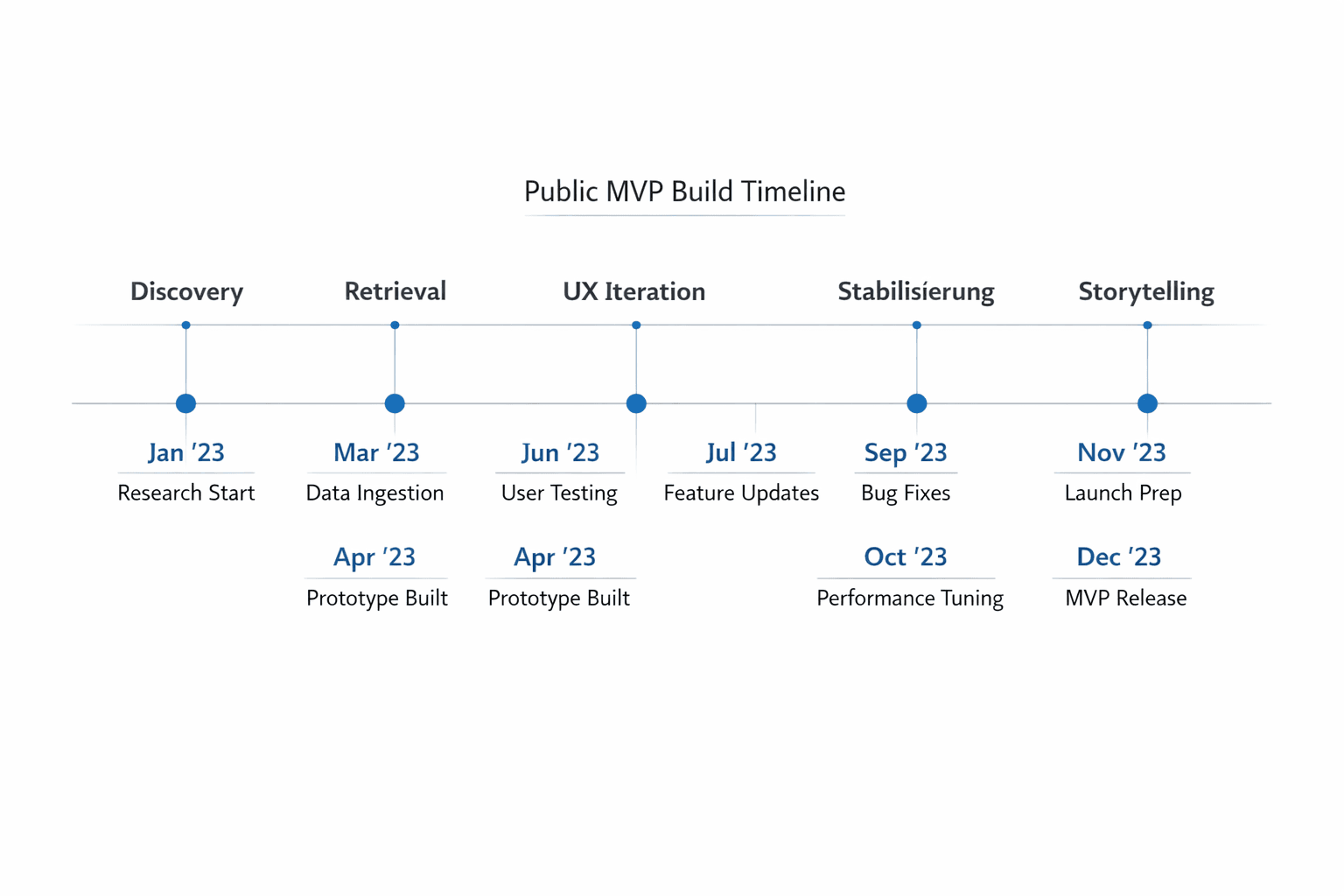
Public MVP timeline
Learning 1: Scope Discipline Beats Feature Euphoria
The biggest risk was not technology, but scope drift. As soon as the first features became visible, new ideas kept appearing. That is normal, but dangerous.
What helped:
- clear prioritization based on user impact
- small, reviewable increments
- visible quality criteria for each story
Without that discipline, the MVP would quickly have accumulated too many half-finished surfaces.
Learning 2: Seed Data Is Product, Not Just Test Material
GraphRAG lives or dies with the quality of its nodes and edges. Weak seed data leads to weak answers, no matter how capable the model is.
I had to learn early that seed data needs the same level of care as UI copy or API design.
Important principles:
- unique node types
- clear relationship semantics
- traceable sources for every reference
- meaningful short and long descriptions
Learning 3: Transparency Beats "Magic"
Users trust AI answers more when they can see how the result was formed. That sounds trivial, but it is demanding in practice.
It is not enough to attach "sources" at the bottom. You need a UI that makes the path to the answer visible:
- which nodes were selected
- how they are connected
- which evidence was used
- how the synthesis is formed from that structure
This point turned out to be one of the strongest drivers of better usability.
Learning 4: Graph Visualization Is Its Own Product Problem
Many people underestimate the visualization part. "We will just show the graph" sounds simple. In practice, it was one of the hardest parts:
- node overlaps
- unclear edge labels
- overly dense layouts
- inconsistent tooltips
The solution came through iterative UX work: layout presets, zoom/fit, context filters, node details, mini-map, and focus modes.
Learning 5: Prompt Transparency Is Not a Nice-to-Have
One recurring question was: "What exactly goes to the LLM?" That was a crucial signal. Without prompt transparency, the process remains a black box for users.
That led to introducing a prompt inspector that makes LLM-only and GraphRAG visible side by side. It helped not only understanding, but also quality discussions within the team.
Learning 6: An LLM-only Comparison Creates Instant Clarity
The direct comparison between LLM-only and GraphRAG turned out to be one of the strongest educational levers. Do not explain it only in theory. Show the two variants next to each other:
- What is missing without the graph?
- Where does the reasoning become weak?
- Which parts become more robust with GraphRAG?
That way, the value is not merely claimed, but experienced.
Learning 7: Runtime Stability Needs Early Guardrails
A public MVP needs more than a working happy path. It needs robust error paths and runtime boundaries.
Important guardrails:
- clear error messages instead of silent failures
- visible UI states such as loading, empty, and error
- defensive fallbacks in context selection
- clean local/production separation for data and keys
This work feels "invisible," but it is essential for trust.
Learning 8: Documentation Saves Time When It Stays Focused
Many teams document too late or too broadly. In this project, short operational documentation with clear handoffs proved helpful.
What worked:
- focused story artifacts
- a clear status flow
- concrete test and QA steps
That reduced back-and-forth and sped up iteration.
Learning 9: Public Architecture Must Be Tellable
The technology was solid, but external impact only appears when you can explain the architecture in a way people understand.
That is where story pages, lab pages, and strong blog articles help. They translate technical depth into a form that speaks to both decision-makers and developers.
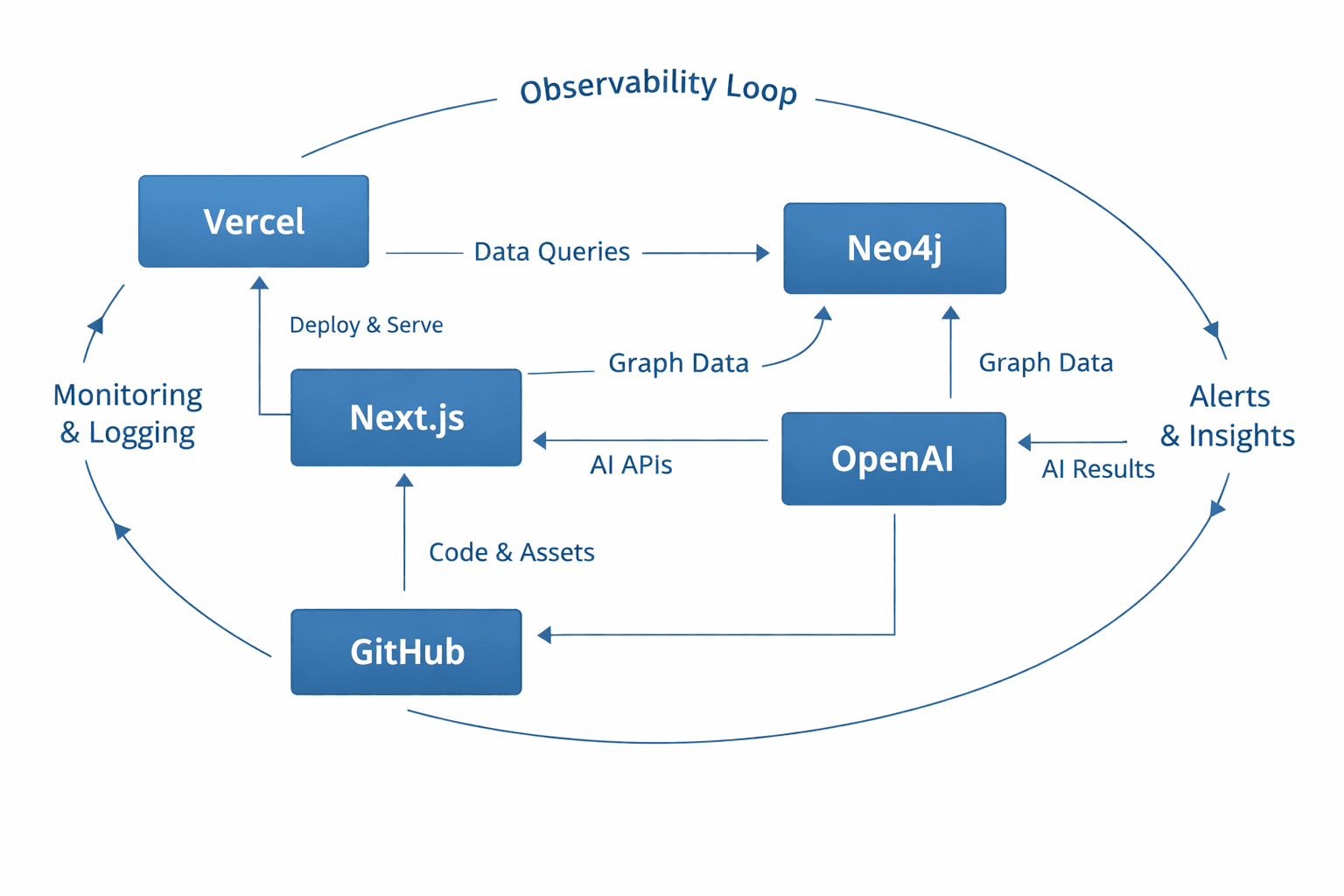 Public stack architecture
Learning 10: Iteration Wins Against Perfection
The MVP did not become "finished" in one big move. It became stable through many small, visible improvements.
What mattered most was a pragmatic rhythm:
- see the problem
- implement a small change
- validate it immediately
- move on to the next bottleneck
That loop was more productive than big refactor plans without immediate impact.
What I Would Do Earlier Next Time
- Start content design earlier instead of waiting until after feature implementation.
- Introduce comparison views earlier such as LLM-only versus GraphRAG.
- Maintain a git-based project chronicle from day one so lessons learned can be communicated faster.
Limits of the Project
A public MVP remains an MVP. It has limits:
- no fully automated content distribution
- limited editorial depth per topic
- no complete enterprise operations model
Those limits are fine as long as they are transparent.
Concrete Recommendations for Similar Projects
If you are planning a public AI project yourself, start with these priorities:
- a clear user question
- a limited scope
- traceable reasoning
- solid runtime guardrails
- continuous UX iteration
That gets you to a result faster that does not just work, but convinces.
Conclusion
The biggest lesson was this: technology alone does not create a strong showcase. What matters is the combination of resilient architecture, strong data foundations, traceable UX, and a clear story.
Building in public increases pressure, but that pressure improves the outcome. If you structure the process well, a technical experiment becomes a credible product signal.
Deeper Reflection: Why Public Projects Force Stronger Product Thinking
In internal projects, many things can remain implicit. In public projects, you have to make them visible. That changes the quality of decisions.
As soon as real users or potential customers visit the site, every vague term, missing piece of evidence, and restless UI becomes obvious. That can feel exhausting, but it is a huge advantage: it forces precise communication.
That is why public labs are so valuable for teams that want to build production-grade AI systems later on. They train not only the technology, but also product thinking under real visibility conditions.
Editorial Framework for Medium and LinkedIn
A repeatable framework helped me publish content faster while keeping quality high:
- Hook in one sentence
What exactly is this about, and why should someone keep reading? - Start with an everyday problem
Do not begin with architecture. Begin with a familiar pain point. - Present the technology as the answer to that problem
Do not explain it in the abstract. Anchor it in the concrete problem. - Name trade-offs explicitly
Credibility rises when limits stay visible. - End with practical action
What can the reader do tomorrow?
With this framework, a technical lesson learned turns into content that works on both Medium and LinkedIn.
Operational Checklist for the Next Expansion
For the next expansion phase, this sequence makes sense:
- first readability and visual hierarchy
- then story interaction and narrative depth
- then content length and graphic quality
- finally distribution and reach
Why this sequence? Because strong distribution without clear product and content quality only creates more reach for mediocre material. Only when substance and presentation are already strong does more aggressive distribution pay off.
That prioritization made a real difference in the project. Only once readability, reasoning, and technical stability aligned did the external signal become strong enough to trigger real conversations with interested teams. That relationship is not accidental, but a reproducible pattern in public tech showcases.