Systemic practice
Context Discipline: Why Less Context Often Produces Better Answers
Not the amount of context, but the quality of context determines whether answers stay stable and reviewable.

Executive Summary
More context does not automatically lead to better answers. Context discipline means feeding only relevant concepts, clean relationships, and prioritized evidence into the derivation. That improves consistency and decision readiness.
Core statement
More context sounds safer, but in practice it often creates more noise. Context discipline is therefore a quality principle, not a cost-saving mode.
Core Thesis
Many teams try to increase answer quality by loading as much context as possible into the model. That feels intuitively plausible: more information should lead to better results.
In practice, the opposite often happens. Too much context increases complexity, blurs priorities, and makes clean derivation harder. Decision readiness does not emerge from context volume, but from context clarity.
Context discipline hero
Problem Context
In production RAG or GraphRAG systems, the temptation to "play it safe" appears quickly:
- better include five more documents
- better add more evidence
- better pull in more neighbors from the graph
- better use larger context windows
The assumption behind this is simple: if something is missing, the context must have been too small.
Typical symptoms of missing context discipline:
- answers become longer, but not clearer
- rationales feel diffuse
- core concepts implicitly shift their meaning
- follow-up questions lead to unstable derivations
The problem is not the model, but the context architecture. In many teams, that architecture stays implicit: context-selection parameters grow, limits are raised, and additional sources are switched on. That produces more material, but rarely more orientation.
Structural Analysis
1. Context Is Not Storage, but an Argument Space
An LLM does not process context like a database join, but like a probability space. The more heterogeneous signals it contains, the larger the room for interpretation becomes.
Without clear prioritization, the model can:
- over-weight secondary information
- mix implicit assumptions
- serve competing narratives at the same time
Context therefore has to be curated, not maximized. In practice, that means asking not "Which additional content might also be useful?" but "Which content really supports this specific derivation?"
2. Relevance Is More Than Semantic Proximity
Semantic similarity alone is not enough. A paragraph can be topically close, but structurally irrelevant for the decision.
Context discipline means:
- defining the decision core
- identifying the central concepts
- including only relationships that contribute to the derivation
Not every related piece of content is decision-relevant. This distinction often produces the biggest quality jump in production setups: from semantically "similar" context to structurally "supporting" context.
3. Overload Reduces Derivation Stability
The more unweighted elements sit in the context, the higher the probability that slightly changed questions will cause different aspects to dominate.
That leads to:
- inconsistent argumentative foundations
- varying evidence paths
- declining trust in answer stability
Stability emerges from clear, explicit boundaries. A tight, well-prioritized context is not "too little"; it is often the exact precondition for reproducible results.
4. Context Discipline as a Quality Criterion
A production-grade system should therefore ask:
- Which nodes are truly relevant for the decision?
- Which relationships support the core thesis?
- Which evidence is necessary, and which is merely decorative?
- How does the answer change when irrelevant elements are removed?
Less context can often make an answer more precise and more robust.
Practical Example
Assume a team is discussing the introduction of a new service model.
An overloaded context might contain:
- market studies
- internal guidelines
- technical architecture details
- compliance rules
- historical project reports
The model receives a broad but blurry picture.
A disciplined context, by contrast, contains:
- clearly defined target criteria
- explicit dependencies (for example cost -> scalability -> risk)
- prioritized evidence
The result is usually shorter, clearer, and more consistent under follow-up questions.
The team discussion then shifts from "What else is in there?" to "Which relationship actually supports the decision?"
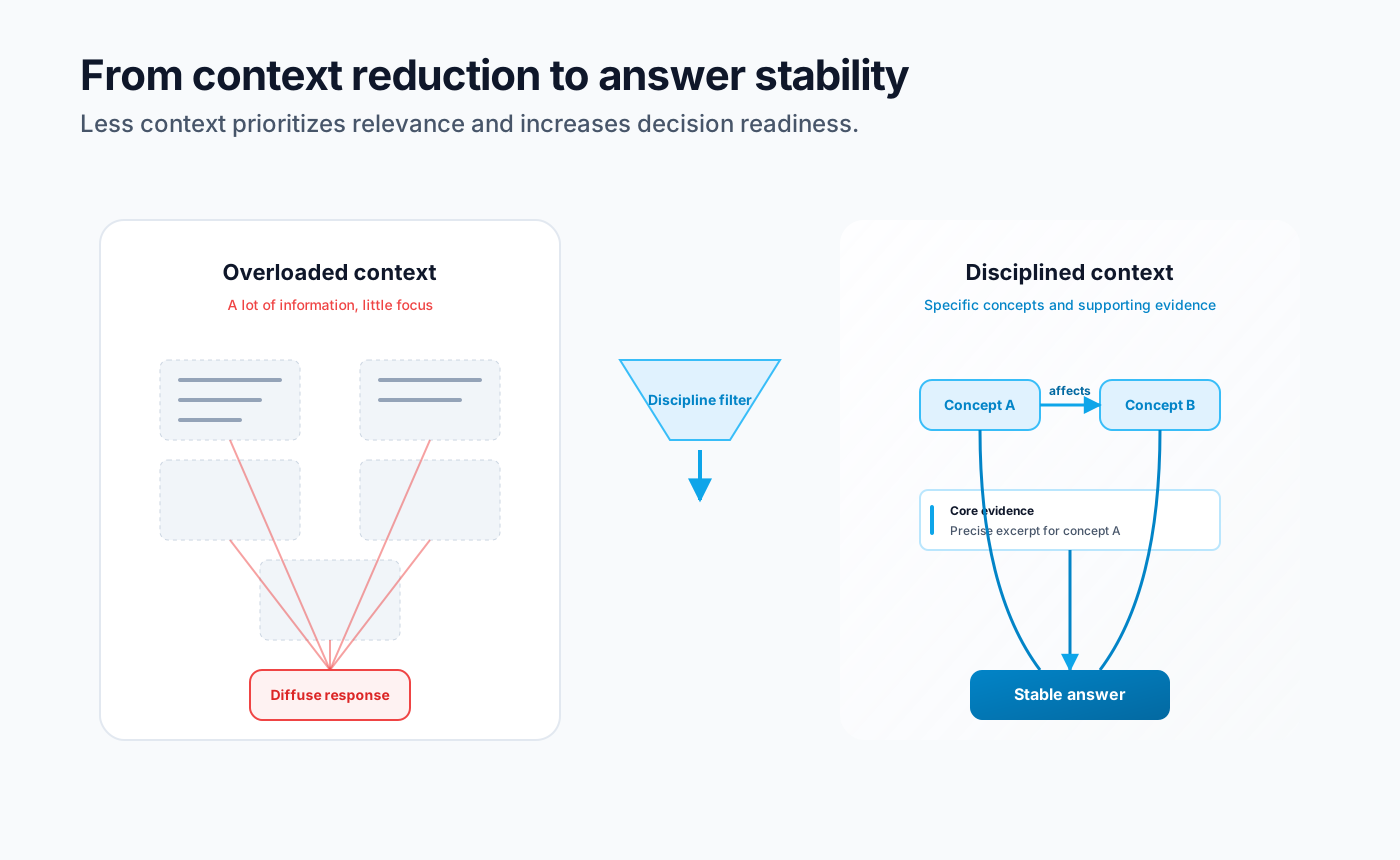 Reduction from context to stable answer
Measurable Quality Signals
Context discipline should not be judged only by intuition, but by observable effects. In practice, four signals have proven especially useful:
-
Answer focus
Does the share of side arguments decrease while the density of directly relevant statements increases? -
Path consistency
Do core derivation steps remain stable across semantically similar follow-up questions? -
Review speed
Do domain experts need fewer follow-up questions because rationale and evidence are clearer? -
Conflict rate
Does the number of contradictory answers to comparable questions decline?
This perspective helps treat context discipline as an engineering and quality problem rather than a style preference.
Limits and Trade-offs
Context discipline has costs:
- more curation effort
- a need for clear concept classes
- the risk of excluding relevant aspects too early
If reduction becomes too strict, blind spots appear. Context discipline is therefore not minimalism, but deliberate prioritization.
A practical approach is iterative:
- Start with a narrow core context
- Review the answer
- Add missing aspects deliberately
- Stabilize the structure
The goal is not the smallest possible context, but the most reliable context.
Organizational Impact
Context discipline changes not only answers, but also collaboration. Overloaded contexts often trigger meetings about material volume. Disciplined contexts shift the discussion toward structural quality.
That has concrete effects:
- decisions become easier to explain
- ownership becomes easier to assign
- documentation becomes reusable
- follow-up decisions build more consistently on prior work
Especially in organizations with multiple stakeholders, this is a major lever because decision quality depends not only on the output, but on shared traceability.
Practical Pattern for Everyday Work
A common misunderstanding is that context discipline can only be achieved through heavy ontologies or large governance processes. In practice, a small and clean start is often enough.
A robust starter pattern:
- Define exactly three core concepts per decision question.
- Set at most two supporting relationships for each core concept.
- Link every core concept to at least one reliable piece of evidence.
- Generate a first answer from this core context alone.
- Expand the context only if a concrete gap can be demonstrated.
This approach prevents teams from accumulating context "just in case." Instead, a controlled expansion process emerges that improves quality from one iteration to the next.
A simple stop criterion helps as well: if an additional source does not change the central derivation question, it stays outside the core context. That turns relevance into an operational rule instead of a vague feeling.
Conclusion
More context does not automatically mean a better answer. Decision readiness emerges from clean context architecture.
Context discipline means:
- clear concepts
- explicit relationships
- prioritized evidence
- controlled expansion
Only when context is designed consciously does stability emerge in argumentation and decision processes.
It is not context volume, but context form that determines whether answers are reliable.
The next essay examines what concrete quality criteria for a production-grade GraphRAG system look like in actual operation.
Next Steps
- Analyze an existing decision question and reduce its context radically to core concepts and relationships.
- Compare answer stability under narrow versus overloaded context selection.
- Define explicit criteria for when context may be expanded and when it may not.